Category: A few thoughts

quick scribbles

  • AI Colleagues

    AI Colleagues

    The discourse around AI in the workplace typically revolves around two narratives. The first narrative is AI replacing human jobs. The second is humans managing AI systems. However, a more compelling possibility is emerging—AI systems functioning as true colleagues that amplify human capabilities.

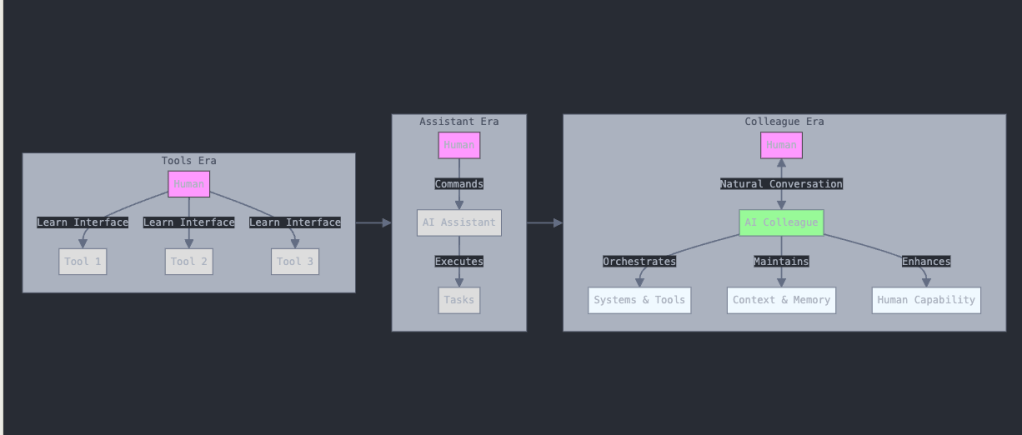
    This shift mirrors a clear evolution in how we interact with technology in the workplace. We transitioned from a Tools Era. During this time, each application required learning specific interfaces. Then we went through an Assistant Era of basic command execution. Now, we’re entering what might be called the Colleague Era. In this era, AI systems engage in natural conversation. They orchestrate work and enhance human capabilities.

    Consider how effective colleagues improve our work: they don’t simply execute tasks or issue directives. They help refine our thinking, identify blind spots, and maintain momentum across complex projects. Early implementations of this approach are appearing in products like Meter Command and Rox. Here, conversation transcends basic chat functionality. It generates interfaces and orchestrates systems through natural dialogue.

    The fundamental insight isn’t technological—it’s relational. The most valuable professional relationships aren’t built on delegation or management but on collaborative enhancement. A true colleague helps you think more clearly while maintaining crucial context across interactions. This suggests a new model for workplace AI. These systems are designed to enhance human capability through natural collaboration. They are supported by sophisticated language models and specialized AI systems working in concert.

    The implications extend beyond convenience. Rather than mastering numerous rigid interfaces, we could express intent naturally and let AI colleagues manage complexity. Instead of constant context-switching, we could maintain continuous, productive conversations that orchestrate work seamlessly. Organizations that grasp this paradigm shift won’t merely possess superior tools—they’ll develop fundamentally different capabilities for problem-solving and value creation.

    This transition represents a progression from learning interfaces to natural conversation, from executing tasks to orchestrating systems and maintaining context. It’s not just about automation or management—it’s about partnership and growth. And this future is materializing faster than most realize.

    The companies that understand and embrace this shift will gain a significant advantage. They won’t just have better tools; they’ll have fundamentally different capabilities for solving problems and creating value. Their teams will work differently. They will think differently. Ultimately, they will achieve outcomes that weren’t possible in the Tools Era or even the Assistant Era.

    As we move into this new era, the question to me isn’t whether AI will replace or assist us. Instead, it’s about how we can build true collaborative relationships with AI systems. These systems should enhance our capabilities and transform how we work.

  • 11/09 Thoughts

    AI SDR / BDR

    We’re at a very unique time where we’re seeing a particular brand of company just doing exceptionally well. They’re all going from 0 -> 1mm ARR really quickly, and then making the leap to adding 1mm arr monthly, to I’m sure a wholly different level.

    • Full Automation: Unify / 11x / Artisan / Reggie (Spam cannon?)
    • Enablers: Nooks / Clay and more.

    Today, it’s working. People are spending $3-5k a month to super charge their lead funnels, outreach, and nurturing. Sometimes, 30-50k. These were being automated to a degree in the past, but now they’re at hyper personal, and only with compute as the limit.

    They have a unique loop at this time where, they’re using their own software to sell their software, and that’s a good reason why they’re going so quickly. Which means, why everyone will likely sign up. “I can 2x my funnel without hiring another person, sign me up” goes every exec.

    These companies won’t be limited by the previous SaaS spend in these areas, but will now have access to the entire SDR hiring budget previously.

    Seeing these extreme successes brings a few important questions top of mind:

    1. Where will these companies exceptionally succeed or fail? Will it be about ICP? Will it be about product type?
    2. What happens when every company has the same tools?
      • We might see this play out sooner rather than later by watching them compete with each other?
      • Does the email inbox or phone number finally asymptote as a valuable channel? Or will not be different than the warnings of the last 25 years?
    3. Will all these companies end up in the same space as the companies approaching it from CX (Decagon, Sierra, Parahelp, etc)

    Exceptional Talent

    Building launchpads for young people is something that does good in the world. It lets those who haven’t yet had their first break, get chance to do something they’re quite passionate about with a wind in their back. That would could alter the trajectory of their life, but also also of hundreds, thousands, and sometimes millions of lives. This applies across all domains, but I’ve always been particularly interested in those who want to invent technologies and build businesses.

    I try to live up to this as frequently as I can. I bring this up for two reasons:


    1. Kothari Fellowship – My friend Nikunj, and his brothers Pranav and Akshay, launched a version of this for young talent in India! I’m so excited for this to exist and looking forward to tracking, both, the initiatives progress and the people coming of it!
    In their classy style, they did it as a Notion page and posted on their socials.

    2. Taimur & Lukas – They’re brilliant folks I met back in 2020(?). Their company, an investment I eventually made, Causal, got acquired. In their email to investors, I got a shoutout that aligns perfectly with this intention of mine in the world.

  • Accenture for People

    I’ve been tinkering with Claude 3.5 Sonnet, and it’s not just the best model I’ve used, but the best UX for building together with a digital copilot. It makes me wonder: what does this mean for software applications in the future as the barriers to software development go down.

    I think truly personal apps could be one emergent pattern. I imagine software that knows my habits better than me and adapting to that is coming soon.

    Taking it further though : Could we see the rise of “personal software experts” who craft bespoke apps?

    Accenture did this for companies extremely well over the last 20 years. I believe the same can happen for the people too. Maybe it’ll look like another AI helping you do it, or maybe it’ll be somebody who observes how I work and then goes out and builds me the best task management app for me. And then 2 years later, when my behaviors change, they’ll come back and update it too?

    This possibility excites me!

    These ideas sparked during a recent chat with Parteek!

  • Thinking about COVID-19

    NOTE: THIS IS NOT MEDICAL ADVICE. YOU SHOULD GET TESTED FOR COVID IF YOU CAN AND FOLLOW NECESSARY TREATMENT. THIS IS A THOUGHT EXPERIMENT AT THIS TIME OF WHAT HAPPENS IF THE SYSTEMS ARE OVERWHELMED. ITS A SCRIBBLE.

    I’m thinking through my thoughts out loud – please tell me why this is absurd to even think about.

    One of the top ideas that’s out there is to flatten the curve: which means that we should try and load balance to avoid overwhelming our health care system. This includes testing and treatment infrastructure.

    One idea I’ve been thinking about given following information / constraints is if anyone

    1) under 30 starts seeing any symptoms and

    2) are not known to be at-risk, when

    3) the country is lacking infrastructure:

    COULD it make more sense for them to start following protocol as if they’ve tested postive to manage from home instead of heading to the hospital and keeping beds and testing kits open for older/at-risk folks?

    To thinking through whether this a bad idea or not, I’m trying to find the following info / answers / account for these thoughts:

    • clearly defined symptoms:
      • read about body aches, fever, cough, runny nose, chills, and some more
    • what pre-existing conditions make you at-risk?
    • find data on mortality / recovery rate for <30 y/o folks
    • what happens when you test positive for COVID 19 and you get checked-in to a hospital? what treatment do they follow? when do escalations happen?
    • in the countries where they’re turning away people from hospitals, what’s the protocol of things they’re asking you to follow? eg. drink lots of water, stay away from people, take x,y,z medicine which are available off the counter
    • by when should you expect to recover? If not recovered by then, how to inform the hospital and get elevated care?
    • the template for informing people you’ve been in contact with that you’re taking precautions and self-isolating
    • what if this springs people who don’t even have it to start taking precautions and social distance/isolate preemptively?
    • will it cause a mass panic / hysteria if people start getting messages from people about their safety?
    • what else?

    I know a few young people who’ve had the symptoms, tried to get tested last week and couldn’t, went home – slept for a few days, some some fever & cold medicine, plan to stay isolated for 2 weeks, but feel like the worst is gone and are making a full recovery. Now, of course we don’t know if they had it or not, but it’s encouraging that they feel fit enough to stand up again. could young people staying at home even when sick save lives because nearly all of them will recover anyway assuming we have a protocol for when they escalate and head to a hospital?

    Update: It looks like the Ohio Government is recommend this policy as well. and here’s a lot of relevant links to this idea.

    Symptoms: https:/ /themillennialmind.substack.com/p/what-to-look-for

  • $5k Angel Investments: Uber Seed

    $5k Angel Investments: Uber Seed

    This is a screenshot of the supposed amounts invested in Uber’s seed round from way back when.

    Assuming it’s real, I was pleased to see the existence of (a couple) $5k check(s) on Uber’s cap table. That’s all.

    P.S long live smallchecksociety.com

  • 2019 Books

    Reverse chronology order of books read this year. Goodreads here.

    1. The Ride of a Lifetime: Lessons Learned from 15 Years as CEO of the Walt Disney Company
    2. The Passage of Power (The Years of Lyndon Johnson, #4)*
    3. Newcomer (Detective Kaga, #2)
    4. The Prize: The Epic Quest for Oil, Money, and Power
    5. Working: Researching, Interviewing, Writing
    6. The Mastermind: Drugs. Empire. Murder. Betrayal.*
    7. Norse Mythology
    8. The Anarchy: The East India Company, Corporate Violence, and the Pillage of an Empire
    9. Liar’s Poker
    10. The Devil in the White City: Murder, Magic, and Madness at the Fair That Changed America
    11. My Family and Other Animals (Corfu Trilogy, #1)*
    12. Kochland: The Secret History of Koch Industries and Corporate Power in America
    13. The State of Affairs: Rethinking Infidelity
    14. The Outsider
    15. Say Nothing: A True Story of Murder and Memory in Northern Ireland*
    16. Consider the Lobster and Other Essays
    17. Propaganda*
    18. City of Thieves
    19. Chaos Monkeys: Inside the Silicon Valley money machine
    20. The Fish That Ate the Whale: The Life and Times of America’s Banana King
    21. Barbarians at the Gate: The Fall of RJR Nabisco
    22. Stories of Your Life and Others
    23. Let My People Go Surfing: The Education of a Reluctant Businessman*
    24. Unbroken: A World War II Story of Survival, Resilience and Redemption*
    25. The Last Days of Night
    26. To Engineer Is Human: The Role of Failure in Successful Design
    27. A Spy Among Friends: Kim Philby and the Great Betrayal
    28. Wild Company: The Untold Story of Banana Republic*
    29. The Accidental Superpower: The Next Generation of American Preeminence and the Coming Global Disorder*
    30. Letters from a Self-Made Merchant to His Son*
  • Crossborder SaaS

    For some time there have been Indian companies building SaaS products and selling it across the world (Zoho/Freshworks/etc.) but we’re now starting to see global companies thinking about how to sell and price their products in India.

    While India’s nowhere near the next top destination for selling SaaS in terms of short-term revenue opportunities, rough ordering being the US, EU, ANZ, then rest of the world, it must be falling on folks radar to build a presence and more so a brand here. If India’s Slack and Segment are indeed Slack and Segement then there’s lower likelihood of a local company to having fertile grounds to build solid foundations in a relatively incubated fashion which could then leverage to compete with across the world.

    What’s gotten me thinking about this is stumbling upon Slack’s India pricing. If your company is located in India, then you only pay 40% of their regular plans (60% off!). That comes out to to about $3.2/mo or about ₹220 per employee per month or ₹2200 per employee, annually. Even at Slack’s margins I cannot imagine this being “worth it” so to speak.

    I look forward to seeing how this plays out in the next couple years. In which sectors do companies take the market in India and if Indian which markets do they take across the world. I have hunches on how this will play out but look forward to watching it closely.


  • Switching from Audible to Scribd…^ Some Links Related to Audio

    When somebody mentions “audiobook” there’s a high probability you’d probably think of the Amazon-owned entity, “Audible”. I, too, did for the longest time. I didn’t even think anyone else offered audiobooks. Plus, I’ve been on an Audible annual subscription for about two years now. Tweeting on something related to this, Jackson tweeted back basically saying: Scribd > Audible.

    Scribd: My last memory of this site wasn’t much. My memory extended to needing to upload a document to get credits which you then used to download a different document…and it not having a great interface. That was probably back when I was in college. I didn’t know they did anything else. Visiting their website, it looked like they’ve added significantly to their offering: Unlimited books & audiobooks for $8.99? Plus a clean inteface? I’m intruiged.

    Essentially if I read more than 1 book a month it was cheaper than the Platinum Annual plan (~$9.5/book). Plus, it would give me the flexibility to abandon any books I didn’t like. It made sense to sign up.

    I signed up for the service last month (Jan) to test out the service and test the depth of the catalogue. About 70% of the titles I had previously purchased on Audible were available and the same with the next 10 titles I had hoped purchase, 7 of them were available. Good enough for me to switch behaviour and potentially unlocking some latent demand to consume even more…maybe more than 1 book a month.

    Hence, I didn’t renew my subscription to Audible with the plan of using Scribd + purchasing any titles it didn’t offer directly from Amazon. The only downside to this remains not owning the title and being locked into the subscription for as long as I’d like to use their audiobooks — not dissimilar from the expectations you’d already have from subscribing to a Netflix.

    If you currently subscribe to Audible, I’d encourage you to look into Scribd (#not-an-ad). They’ll even throw in an annual subscription to Pocket & Blinkist.

    Scribd raised $22mm in 2015 from Khosla and other folks…they’ve had this available for a while. It should definitely drive up audiobook consumption https://techcrunch.com/2015/01/02/scribd-khosla-funding/. Here’s a recommendation of books from Scribd (and Opendoor) board member Keith Rabois (@Rabois) to get you started.

    More on audio

    All of this got me thinking a bit more about (non-music) audio in general. Here’s a loose collection of links/unstructured thoughts.

    • Audio drives consumption. Voice is the complement that drives creation.
    • We’re seeing audio become more and more mainstream as potentially the next big platform. We’re already seeing the growing numbers for increased consumption of audiobooks and podcasts and could extend further.
    • Audio – Demand:
      • One part is no doubt driven by the growing popularity of AirPods – personal consumption. See “AirPods Have Gone Viral” – LINK (High visibility, social signalling, and something different). “AirPods Are Now One of Apple’s Most Important Products” – LINK
      • Another part via the in-home voice assistants: Alexa, Siri, Google etc. LINK, LINK
      • Growing podcast revenue proxy for increased demand from consumer. LINK Efficacy of listening: NYT Op-ed LINK Industry report on Audiobooks LINK.
      • Dive deeper into Sirius to understand more about the biggest audio platforms of yesteryear: radio. Radio is a $40b ad business. LINK What’s the transition here. Maybe there isn’t one Sirius bought Pandora…x-sell users and maintain base?
    • Voice – Supply:
      • We’re also seeing an increase in creation tooling eg. Anchor acq Spotify (Podcasts) and Voiceflow (bots).
      • More picks and shovels will be built. including ad tooling, analytics, content moderation, user verification, etc.
    • Exclusive Supply:
      • As all of this happens: owning exclusive content and apps (skills) will start to become more and important. Ben Thompson (aggregation theory) has more which touches on this topic in his post about Spotify acquisitions LINK.
      • Audible has Originals already. Spotify has Gimlet. What’s the equivalent for Scribd?
      • Are original audiobooks similar to super in-depth podcasts like Hardcore History?
      • Would such titles ever make it to being in a book format? Will they become more interactive: either with the screen as the second medium or via interactions?
      • Certain skills will be available on one device and not another. I cannot find any good examples of this right now.
      • Will we see more dedicated production houses? Is Serial an equivalent to Game of Thrones for HBO? How many more podcasting production houses will we see?
      • There was the crazy $500mm deal for Howard Stern back in 2004 LINK when he joined Sirius. There’s Joe Rogan. Who’s next? Will they go to a platform?
    • Networks:
      • v1 is most obvious here: a social network for audio books (a la GoodReads) or for podcasts (a la Breaker).
      • v2 here will be native to the platform itself: For eg. TTYL (ex-UCLA folks) are attempting to build audio social network and Chai (ex-USC folks 😏) building voice chat for teams.
      • How will these v2 networks interact with the supply not from friends?
      • What’s after this? Will we see existing networked platforms build here? Twitter/Fb/Snap/Google/etc?

    If you have interesting links on the audio space and/or are building something is this space, I’d love to chat: me@varadhja.in or @varadhjain.

    P.S. Any good newsletters in this space?

  • BCC Protection


    Picture

    At Opendoor, there’s a healthy default towards transparency. While we are a Slack-heavy company, we still use email a good amount–especially for communicating with external parties. However, email and transparency aren’t something that goes hand-in-hand, unless you’re Stripe I II. Luckily, BCC can be used to build openness and keeping relevant internal parties in the loop when emailing external parties. I never really used to BCC or get BCC’d until I worked here but now it’s become indispensable. That being said, getting BCC’d or BCC’ing somebody has also become one of my biggest fears.

    (more…)

  • DBX’s S-1: Bottom’s Up SaaS

    DBX’s S-1: Bottom’s Up SaaS

    The first companies that come to mind as one thinks about users as the gateway into an organization are Dropbox and Slack. While their individual mechanics are different, they’re very good at getting users to join orgs that then pay. In addition to building a 10x better product, they have the strong brand & community that it takes to be installed on day one of a new org; something which is incredibly difficult to nail down and continues to be a holy grail of the fabled land & expand distribution strategy.

    • Dropbox: Win the user in single-player mode and then become the first option as a user thinks about a service for their org (multiplayer mode).
    • Slack: Win the org on day one because there’s zero friction to start on multiplayer mode. Get users as the company’s get bigger and people move companies.

    (More on Single-Player vs. Multiplayer here on CDixon’s blog)

    (more…)

  • Product of the Week: Wells Fargo Card-Free ATM

    A few weeks ago, I saw an interesting billboard by Wells Fargo near one of the first few exit ramps of the freeway after crossing into San Francisco via the Bay Bridge. The billboard illustrated  Wells Fargo’s latest consumer experience/offering – Card Free ATM Access. I was excited because this was one of those product ideas everybody, including me, has probably wondered, “Why it isn’t this a reality yet?”
    I believe the first time this thought crossed my mine  was right after the time I had encountered Venmo in college. I questioned why everything didn’t just work from my phone – the washing machine, the doors, the lights, the vending machine, the ATM, etc.
    (more…)
  • What If You Had Bought $AAPL instead of Apple?

    I could barely sleep last night so I decided to head to my desk and do a fun project: How much money would you have today if you had purchased the $AAPL stock instead of buying the Apple Product? I do recognize the bias of picking the company that has generated the more shareholder value in the last decade but this is still fun to think about.
    (more…)
  • Experiment: Personal Finance


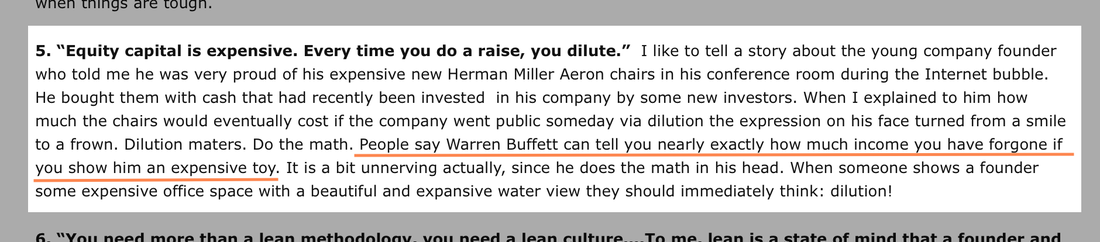
    There were some really fun/good replies to this tweet that was referring to how recently funded startups but super expensive chairs. The one reply that stood out to me was a link to this post written by Tren Griffin on Things [He’s] Learned From Fred Wilson. #5 on that post talks about how expensive equity capital and the importance of not spending it on expensive toys for your company. He adds another way of looking at this, through a Buffet-ian lens. I have highlighted it below. Overall, the paragraph resembles a similar conclusion, from a personal perspective, I came to a few weeks ago.

    screen-shot-2016-09-02-at-6-34-39-pm_orig.png
    Source: Tren Griffin on Things [He’s] Learned From Fred Wilson

    Being somebody who’s curious in general, likes to tinker, and always wanting to play with the newest things I end up messing around with a lot of new software, apps, hardware, and gadgets. In general, I think this is super valuable, especially if you want to make build products/make investments as the earliest stages since a lot of new things starts as toys or not mainstream, by definition. Most of those things are usually just time-consuming and cost a marginal amount of money from your personal cash flow except for gadgets. The latest gadgets *usually* don’t end up being the significantly more product than the gadget that they are replacing: the newest iPhone, newest MacBook, Camera, drone, GoPro, wearable, you get the idea… So instead, what I’m experimenting with is: If I think I would’ve bought this item before doing this experiment, I’m going to buy the equity into that company instead. If the stock is not publicly traded, I’m going to buy an adjacent/related stock that is. Not just applying this to gadgets but any ancillary spending that’s not food & transport. If I do need to make the purchase, I’m going to try and match the spend with an equity purchase. Also, if a spend a LOT of time on the service, that to warrants buying equity in the service.  In the two months, I’ve bought a few shares of AAPL, TWTR, TSM, LULU, JWN, FIT, SQ, ZEN

    The most obvious outcome is that I, likely, own assets that don’t depreciate as fast as the goods I would’ve otherwise. I hope to god that is true because if that isn’t true that would really suck.

    Also, I’ve never really traded public equities before this but I think I’ll learn some things about the company and how others (public/bigger funds) thinks about these stocks since their motivation is obviously very different from mine. The reason for my purchase was just intent to buy/interact with their goods and its possible that good products/services (I like) ≠  good businesses (the world values).  Looking at things retrospectively should also allow me to build a better filter for instances, in the future, that need independent thinking. I may also be able to evaluate what kind of returns some of the toys/services built by public market companies, that I interact with, have. It’ll also, over time, let me track what structural changes have happened in the industries they operate in .

    Again, the main motivation here isn’t extraordinary financial returns because this would be too easy of a way to make money, and anything that is easy has its advantages to competed away as Howard Marks writes here. Additionally, in his words this is a classic example of first-order thinking. I do want to use this as a way to spend less, and skim over annual filings to become familiar before deep diving in the future.

    Disclaimer: I am not giving you investment advice of any sort. This is just an experiment I am doing for myself.

  • Selling Textbooks at UCLA

    Picture

    Earlier today, I tried to sell a few textbooks that had been lying on my desk to see if I could make a few bucks for them before I move up to Mountain View. The process turned out to be harder than I expected.

    Given, the incentives of the system don’t encourage reselling of books at anywhere close to retail prices along with the variability in the condition of the books – I shouldn’t have expected this market to be anywhere close to efficient. I must’ve at least spend $200 on these books combined – yet I couldn’t get more than $30 (15%) back.

    Option 1: Selling it back to the college. At UCLA, there’s a portal where you can see the value of the book should there are at all be any interest in purchasing it back (presumably to resell at a big markup the next year). Unfortunately, there weren’t looking to buy back most of the books.
    School Bookstore – At UCLA – https://shop.uclastore.com/t-buyback_inquiry.aspx
    Price: Low, Guarantee: Low, Difficulty: Low

    Option 2: Selling to other students – primarily through Facebook groups. The good thing is that these are walled market places with relative price insensitivity during the first 2 weeks of every quarter. During the rest of the time the demand is essentially zero. You must be willing to wait for the first two weeks of a quarter or right before it to find a buyer (though you may still not find one). This buy is likely to pay somewhere between 50-75% the price. However it is high touch. This is the best option if you have time on your hands.
    Facebook
    Price: High, Guarantee: Low, Difficulty: High

    Option 3: Book Finders. So I knew Amazon did trade-ins and as did Chegg. However, I stumbled upon Book finder which turned out to be the best option. It quickly surveys a bunch of trade-in options at the national level and find you the highest *low* price 😛 However, if you include the price of shipping – most books don’t become worth shipping since you need to buy the packaging….
    Book Finders – http://www.bookfinder.com/buyback
    Price: Low, Guarantee: Medium, Difficulty: Low
    Funnily enough in college, I was trialling classes for the soon-to-form entrepreneurship minor at UCLA and took a class titled `Business Plan Development taught at the Anderson School of Business. For the class we proposed building something called Textbook Crawler. Good ‘ol days. You can view what our final presentation looked like here.

    Option 4: Donate to your local library. They will usually accept most of the books you intend on donating, however I did find out that the Beverly Hills Library doesn’t accept text books. This also happened to be personally very satisfying for me.
    Santa Monica Library –
    Price: Zero, Guarantee: High, Difficulty: Medium