As a part of my nomadic journey across the world… I was recently in Whistler, Canada. While its usually known for its world-class slopes and pristine nature, one of the highlights was an immersive experience called Vallea Lumina. Initially, I wasn’t sure what it was or what to expect as it was marketed as a multimedia night walk but signed up anyway. It helped that there were little postcards about it all over the city. I didn’t expect much but who wouldn’t get excited by the word multimedia.
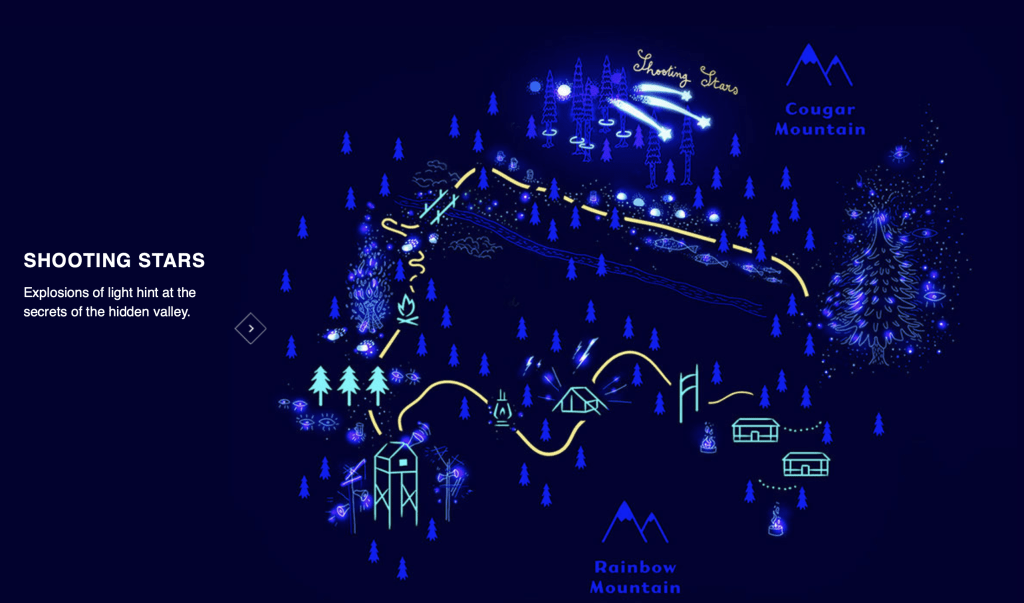
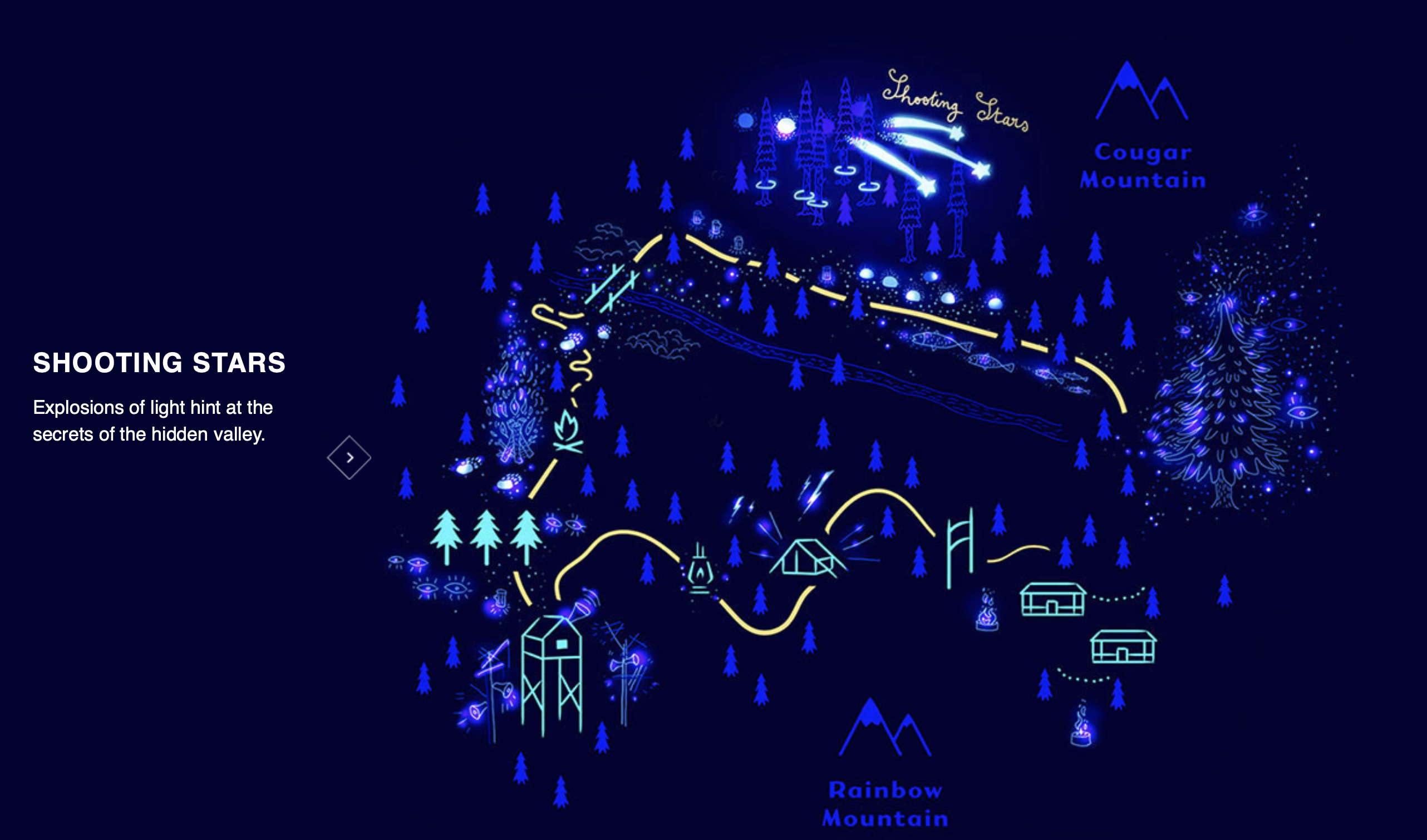
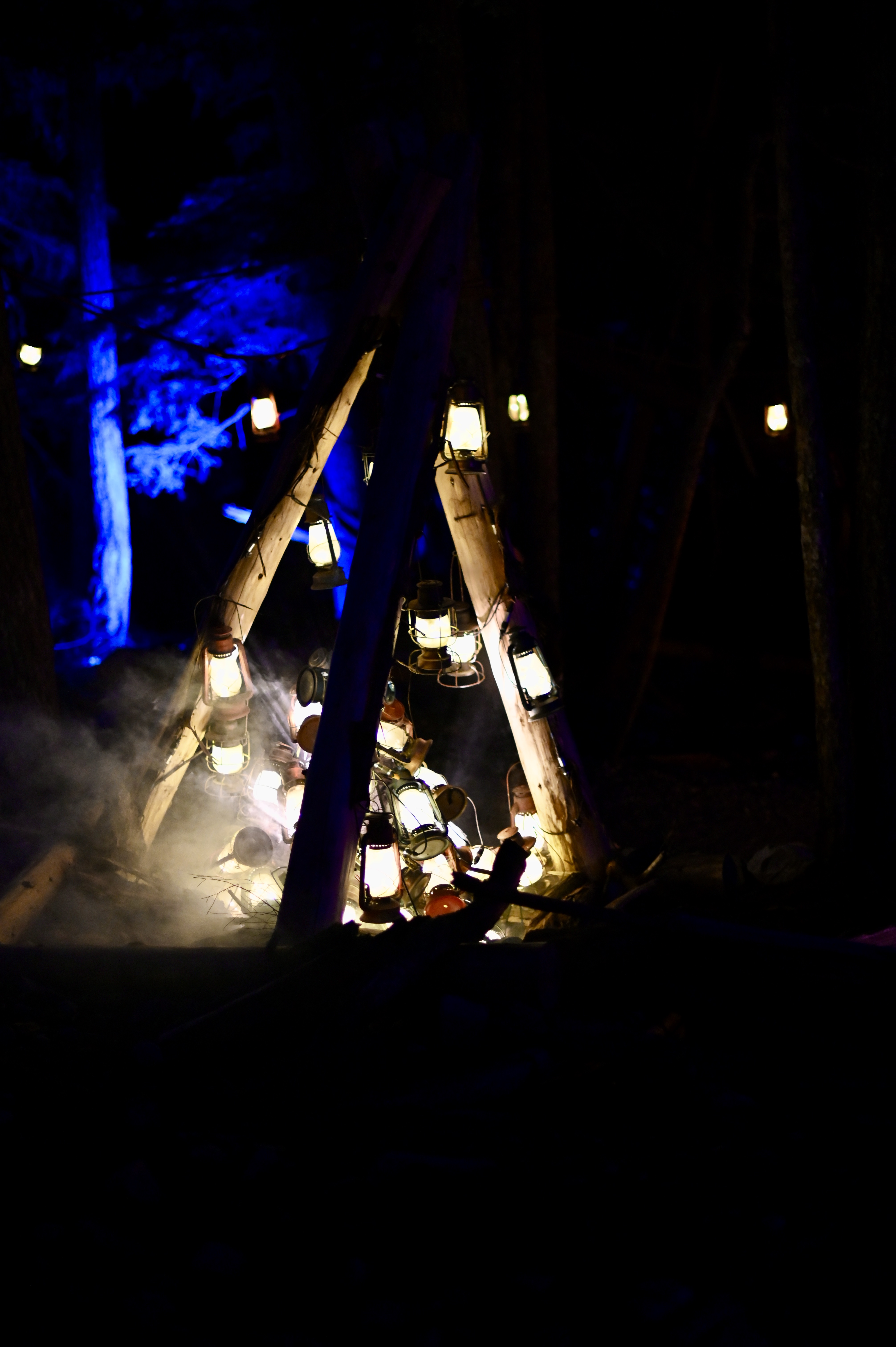
Selecting the last show of the night (9:40 PM, I think), I boarded a bus to get to what looked like a trailhead. At the entrance, you’ve got a solid camp vibe with s’mores and hot chocolates for before you get started (or at the end). It took about 45 minutes to walk through something of a cross between the museum of ice cream, a hike, an EDM party with the themes of camping (lights and music), and mystery. There was a projected skit, a preserved tent with artefacts, a morse code challenge, campfire music, talking trees, and immersive lighting. It turned out to be a unique and pleasurable experience unlike any I’ve experienced before and it was worth every $$.
I think we’ll see many more experiences like this that are very interactive and novel. While people might scoff at the idea of the company that did the museum of ice cream raising $40mm, I’m quite bullish about experiences like that, Vallea Lumina, Dismaland (yes, I get it), and more. There will no doubt be so many new experiences that people of all ages do in groups together and I’m excited for all of it — whether out and about in the world or further into your computing devices(eg. Sandbox VR*).
Whether these are to be one-off co’s that are similar to art installations or true venture-funded companies is TBD but this location Vallea Lumina also appears to be a good business. $40 pp and 600-800 people per night on average is what I heard from one of the people manning the shuttle buses and it increases as the sunsets become earlier. This though does get me thinking what’s Disneyland 2.0?
Some of you might be familiar with a monthly hiking group that I organized for most of 2018. As a part of organizing anything you tend to get a good amount of requests, comments, and questions. For the hiking group, one of the common comments / requests has always been: “this hike looks so hard, could we do a easier one.” Sometimes I would pick a shorter one or one with an easier elevation gain and sometimes I’d be like come anyway and if it gets too hard we can always turn around earlier / cut across to the other side of the loop. When choosing to do the latter, I don’t think we’ve ever turned around. The 1-2 people who were anxious challenged themselves and always pushed through to the end. Something I’ve always been fascinated by: giving yourself an escape hatch but not giving into it.
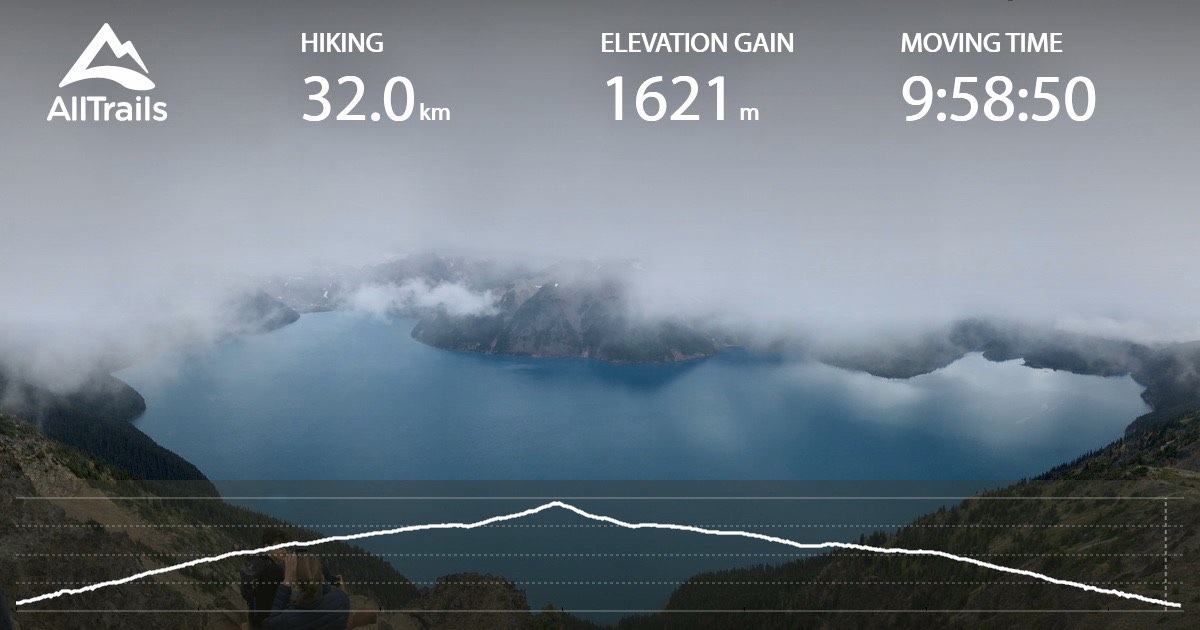
This past weekend, I was in Whistler with plans to checkout Garibaldi Lake. The hike is pretty daunting: 20km and a ~900m elevation gain. However, there’s another way to do it: go all the way up to Panorama Ridge and enjoy the lake from above. Only problem: 30km and a ~1600m elevation gain. Having not hiked for most of this year, I was anxious to even do the former but knew I could make it if I pushed myself. But getting to Panorama Ridge seemed too hard to even think about let alone committing myself to making it to the top. But the views from the top were too irresistible to not try. You know where this going…I gave myself the same talk: I’ll do the trail to the lake and at the fork between the two, I’ll make the decision on which way to go. I could choose to only do the lake or if I was feeling comfortable — I’d go all the way.
I ended up going all the way. It makes me think about two important things: splitting daunting goals into smaller ones and giving yourself an out (but rarely using it). Both have tended to be helpful tools for me. Though the cynic in me always wonders why I need to play these little games with myself but hey, it’s worked well?
How do you approach challenging tasks. Do you ever find yourself with some some tricks too?
In H2 of 2017, at Opendoor we encountered a problem with came with a small threat: it could force us to shut down a market we operated in (low probability) but not nailing it might potentially disrupt or pause operations in all other states we were “live” in should it not be solved. It had to be a cross-functional effort between the brokerage, EPD*, and compliance teams to solve.
I stumbled upon the project largely because I think nobody else had said signed up for it 😬. The story of this project deserves a post in itself but the project ended up achieving its goal, against all odds. Given various circumstances including needing to staff up resourcing quickly, a hard problem, and a looming deadline, in classic Opendoor fashion we retro’d on why we thought the project had succeeded.
I think applies to any project whether it be for yourself, within a company, or even the early days of a startup. It reminded me a lot of how things were when all of us on the Polymail team were living together and doing YC in the summer of 2016.
Clarity – helps align everyone and convince people to join. Simplify how you talk about what you’re doing.
External Deadlines – force prioritization and a ship. (of course there’s caveats here)
Enthusiasm – this sh*t is hard, be excited for it and find amazing people to work with.
Tailwinds – always be able to answer the why now.
People, people, people 💙
This one turned out to be one of my favourite special projects at Opendoor because of the people I got to work with and learn from, the ownership over the problem, the ability to have a meaningful impact, and learning one more pillar of business complexity that we have. Plus it gave me a chance to do what I love doing the most: managing the product and the operations.
The project also ended up having a much larger than our initially scoped impact as we, hi Tim, Visnu 👋🏾, built a brokerage specific transaction management product (Broker Admin), and sped our path to move to our own contract management software (HelloRito) at Opendoor.
Two years ago, I had a deadline hanging over my head to find a new job and renew my visa. Two years ago, I walked into Opendoor SF for the first time with a new job and mostly afraid of how I’d fit into a 200-person company having just wrapped up an adventure at a company of just 4.
It’s been almost 2 years since I joined Opendoor and what an incredible ride it’s been. Looking at my notes from Nov-Dec’16, here’s the story.
Starting things is my default, whether it was thinking about how to capitalize on the fish wire craze in middle school or starting companies with friends after college. So when I left Polymail after we raised our round post-YC, with no plan, the first thing to do was figure out what should I build next. I spent most of October 2016 thinking about would follow. My notes/sketches show me all the things I thought were interesting: another productivity app 💌, a food-related consumer brand, something blockchain-related, a smart factory, and new retail experiences.
While I was dreaming about the next big thing to build, I also had a constraint—my visa status— that I hadn’t fully grasped the impact until an international student counsellor at UCLA reminded me, in November, that I had under 90 days left on my existing F-1 visa. I had only until Jan’17 left in the US unless I found a job that could sponsor my F-1 visa’s STEM extension. Because this threw a wrench in my plans to start something new again, I needed to find a job (and quick).
In general, job searches aren’t a particularly fun experience but I got started on mine. Back when I initially left Polymail I emailed a few folks asking, “If you see something interesting, let me know” but it was time to ping people again. I didn’t know what role I wanted…I didn’t have any specific career goals other than being entrepreneurial and having an impact. As I thought about roles, I had experience and was excited to work on products, analytics, and growth. However, a role itself didn’t seem like the most important pillar when looking for the next opportunity. Instead, I established criteria of what I thought was important to me knowing it would help me make a decision. I had narrowed it down to:
Joining a full-stack startup: Having grown up around operations heavy businesses in India, I wanted to spend time working on a project that would have the whole stack—build the software and use it too.
Talent & Culture: I wanted to work at a place where people I knew and respected worked. I wanted to learn from them.
Scale: I hadn’t worked at a place yet that found product-market fit, scaled, and needed real management. This was something I needed to experience first-hand. Reading books or medium articles were not a substitute here.
There were a bunch of companies with interesting roles, but nothing really matched all three. Serendipitously, Vedika, my sister, who was then working at Stripe told me she swung by the offices of a hot new startup where her friend Logan worked at a place called Opendoor. I looked up the company and at first glance, it appeared to meet my three criteria. On LinkedIn, I noticed that I knew a few folks who worked there, including Simon who I had last met in NYC when he was fundraising for his company at that time.
Some backstory: Simon and I originally met in 2014 when he was working at Robinhood doing PR and I was running LA Hacks where the founders ended up showcasing their app for the very first time publicly. You could say the demo was interesting—ask him about it.
The original email
I swung by the office at 116 Montgomery on a weekend to meet with him. Once there, he introduced me to another PM who was also working the weekend and left us for an impromptu interview…surprise, surprise. To say that the interview didn’t go well would be an understatement. I was later told that the PM thought I was smart, but also thought I spoke too quick. I told him that if the PM I had met wasn’t interested in the next step, I’d still be interested in other roles. He referred me for a different, and more analytics-focused, role. I needed my visa and time was running out. I thought to myself, “Let’s get the job, get the visa renewed, and then see what to do next. I likely won’t last long at a company so big for more than 3-6 months anyway, but at least I’ll have my visa.”
The referral worked on getting an email back from Jac, a recruiter. We spoke on the phone and she sent me a take-home assignment which seemed straightforward enough to do.
One week later, 22nd of Nov, I had somehow forgotten about it in the midst of preparing for a slew of other interviews. I remembered only after I finished the on-site I had that day down in Palo Alto and decided to head to the Stanford coffee shop get this thing done before the end of the day. I finished by around 5 PM, phew. However, given the rush to finish, I didn’t expect a callback. Surprisingly, I heard back and soon found myself scheduling an on-site.
Even with a few offers on the table and the deadline for my visa continuing to approach, I wanted to hold out for Opendoor. Less than 48 hours later, I received a call back telling me more about the offer and the role. However, it came with a hurried deadline and a compensation package that differed drastically from the others. Pay didn’t make it onto the list because it was more of hygiene criteria as opposed to one you could pull the trigger based off of. This would be a bit of a bullet to bite but I was genuinely excited about the company which had satisfied the criteria I set out with and had the opportunity to have a big impact though.
I called back and said, “I’m ready to do this”. My boss-to-be at that time, Ryan Johnson, recommended coming in the next day.
So on Dec 4th, I showed back up at 116 New Montgomery to start my first day at Opendoor. The first project was some product discovery work: call customers and see if they were interested in getting financing. Oh, boy! This was a sign of things to come.
Reflecting two years later, I’m grateful I made the decision I did. I’m lucky that the criteria lead me here to find each of three things I was looking for but also gave, and continues to give, me so much more. Also, the roles basically didn’t matter.
Full-Stack Startup: Opendoor really is a technology and operations business that builds software end-to-end and uses it too. Its fascinating problem set to have an opportunity to take on.
Talent: I’ve gotten to work with people I know, and made lots of friends with people I work with and respect. I’ve gotten also to recruit some amazing folk to come to join us too.
Scale: Opendoor has continued to grow and be successful and it’s amazing to work at a place where we’re impacting the lives of thousands of people every month during the most stressful transaction of their lives.
Thank you, Laura and Saige reviewing early drafts.









 Varadh